Japan's accommodation
market has a gap in it.
Large hotel operators need scale to carry their head-office cost. Assets below a certain room count, assets that do not fit a standard hotel format, and assets where the right operating structure is not yet settled all fall outside what they will take on.
For an overseas investor, the constraint tightens.
Even where a suitable operator exists, the working language is Japanese throughout — reporting, correspondence, negotiation.
We work in that gap. Enquiries, discussions and operating reports are handled in English, directly with the person running the business.
Twelve years, three formats, as principal
In every case we employed the staff and ran the operation ourselves. We are not an intermediary placing assets with third-party operators.
Hotel
Operated under a licence issued pursuant to the Hotel Business Act. No cap on nights of operation. We currently run a 41-room hotel in Chuo-ku, Tokyo under this framework.
Short-term rental
Operated on notification under the Housing Accommodation Business Act, and capped at 180 nights a year. Distribution design, multilingual guest handling and unattended check-in were all developed during this period and carry into what we run today.
Monthly stay
Structured under lease law rather than accommodation licensing, which brings its own requirements — fixed-term tenancy agreements and the rules governing them. Pricing, housekeeping frequency and turnover economics all differ from nightly operation.
Which of these a building can support is determined by its zoning, its building certification and its physical configuration, not by preference. Having run all three, we can tell you which applies to your asset before capital is committed.
Small is harder, not easier
That 41-room count sits below the threshold most large operators will accept. It is also where fixed cost per room is heaviest.
The work does not scale down
A twenty-room property still needs guest handling, housekeeping procurement, regulatory filings and cover for arrivals at any hour. Revenue falls with room count; the operating obligations do not.
Why the majors decline
An operator carrying a head-office function needs a minimum revenue base to absorb it. Below that line the mandate does not pay, so it is declined — which is precisely why owners at this scale struggle to find anyone.
Where automation pays most
The smaller the asset, the higher the labour ratio, and the larger the gain from removing manual work. Cloud PMS, smart locks and online check-in are in production, not under evaluation.
Staffing follows the asset
Staffing is set against the demand a property actually carries, with automation covering what does not require a person present. Larger assets are equally welcome — we are describing where the difficulty lies, not restricting our scope.
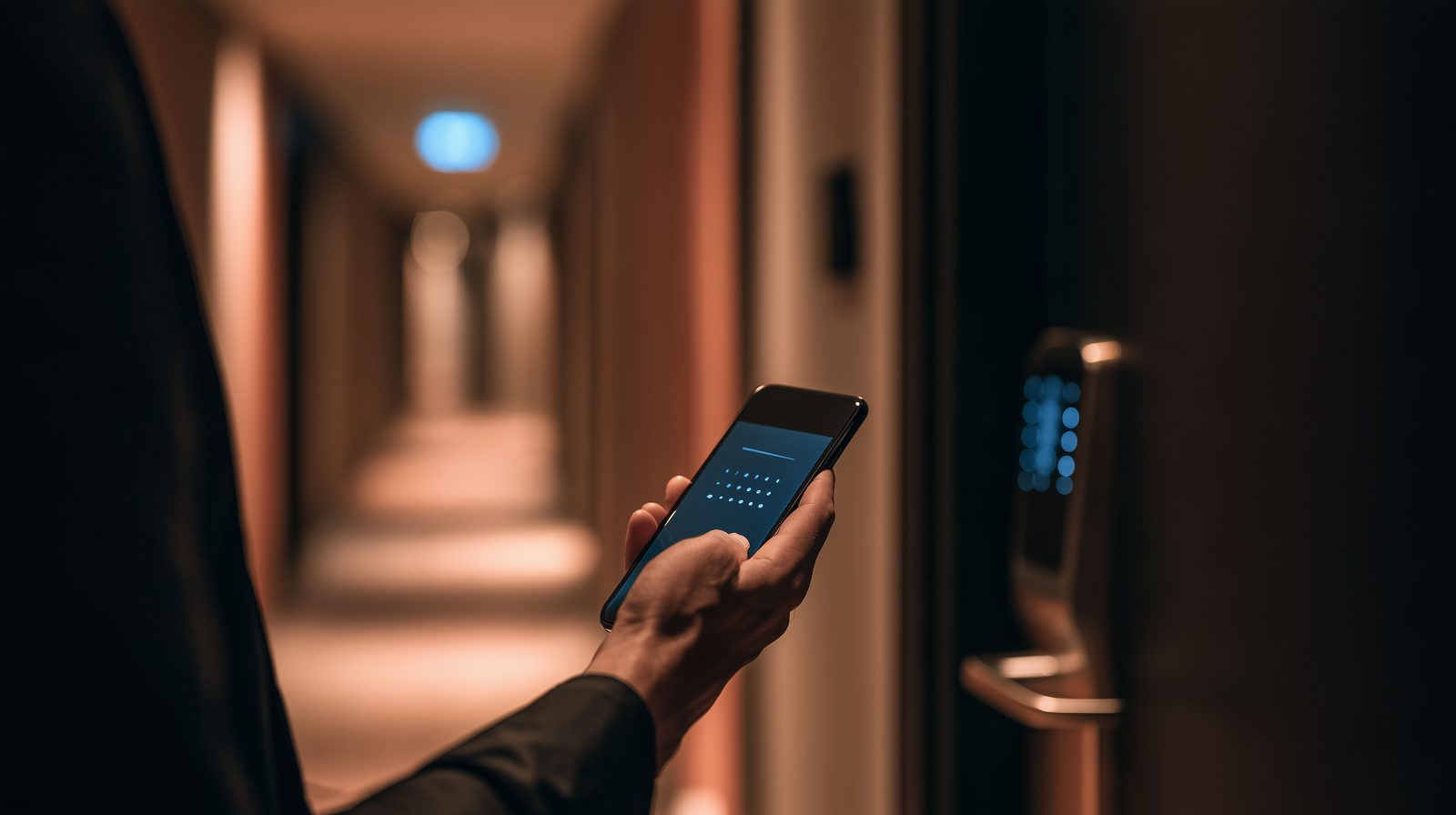
Keyless entry via smartphone, in production at our Chuo-ku, Tokyo property.
When demand disappeared
In 2020 Japan closed its borders. Occupancy at our properties fell to 14% in April.
Borders closed
Roughly six months later
Still no inbound travel
What we did
Rather than wait for inbound travel to return, we redirected the properties toward domestic demand for extended stays. Doing so meant moving between operating formats, since the applicable framework changes with the length of stay — and each carries its own licensing and contractual requirements.
What it demonstrates
Occupancy in a strong market tells you little about an operator. The difference shows when demand fails. Any assessment of an operator should weight downside behaviour at least as heavily as performance in favourable conditions.
Reporting
Under a management contract we provide monthly operating reports in English: revenue, expenses and net operating figures.
Tell us about the property.
We work under both master lease and management contract structures.
We reply within three business days, in English or Japanese.